Showing posts with label Chicago. Show all posts

Tuesday, February 8, 2011

I Spy... With My Little Eye...

... the contents of the blue recycling carts being tossed into the same truck as the garbage! For shame, Streets and San guys! Yes, I am aware that there was a blizzard last week. Yes, I know that many of you had to work overtime to salt and plow all the streets in this city. And I'll even admit that, since the city doesn't plow the alleys, it's a crap shoot as to whether the garbage trucks can even get down the alley ways at all.

But this is Chicago. The city that works. So man up, boys; if you can collect garbage, you can collect recyclables. Our recycling rate in this city is shameful enough as it is; let's not use a couple feet of snow as an excuse to make things even worse.

Wednesday, February 2, 2011

What Say Ye Now, Groundhog?

Here in Chicago, outlandish weather forecasts are not at all uncommon among the local news stations. In fact, a rush-hour flurry or a sudden downpour is usually all it takes for meteorologists to cut in to the evening's top stories with "breaking news" of the (usually obvious) precipitation affecting portions of the viewing area, and to dispatch rookie reporters to the lake front and expressway overpasses to confirm that-- "live, from outside"-- the white stuff that's hitting my window is, in fact, snow.

So when forecasters began making their catastrophic storm predictions last week, I tuned in to Chicago's Very Own, WGN, to see what my buddy Tom Skilling had to say. He is by far the most level-headed, non-alarmist meteorologist in the tri-state area, so as soon as I heard him calmly describe the impending blizzard as a "storm of historic proportions", I took notice. And as it turns out, he was right on the money.

In this (delightfully snarky for NPR) article posted yesterday, an Atlanta meteorologist said (in response to the "monstrous monikers" that have been attached to the megastorms of recent winters):"Just in passing, I've overheard conversations about the intensity and danger of impending storms. People refer to the storm systems by their TV names, which lets me know that being creative gets people's attention."

But since terms such as "Snowmageddon" and "Snowpocalypse" are so East Coast 2010, I'd like to present to you a medley of the Chicago versions, coined specifically for the Blizzard of 2011. Here goes!

Snowly cow! Snowtorious B.I.G. himself has descended upon the Windy City. We've learned that Mother Nature's first name is, in fact, Snowprah, and that no one was excluded from her first "Favorite Things" episode of February. In a shrieking voice, loud enough to be heard over the howling winds, she has declared that, "you get a blizzard... and "you get a blizzard... everyone gets a BLIZZZZARRRRD!" Only this time, it's not just a room full of hysterical middle-aged women in brightly colored tops who are squealing "SNOW-M-G!"; school children everywhere are overcome with joy to learn that, what started as a snowrnado last night has closed even the Chicago Public schools today. And since this blizzaster has all but crippled transportation in the city, tomorrow's not looking good, either.

It warms my heart (but not my hands) to know that residents are banding together in the wake of this snowtastrophy; in this magical time-- after the snowfall has ended but before the lawn chairs appear (to claim "dibs" on their owners' dug-out parking spaces)-- neighbors are helping neighbors clear drifts from their front doors, shovel narrow pathways for brave commuters and dog walkers, and they're also responding to all-too-literal questions of, "Dude! Where's my car?!?"

On my quiet little side street (that probably won't see a snow plow or a back hoe until sometime this weekend), the only modes of transportation I saw in the two hours I was out unearthing my car were el trains, skis, and snowshoes. Plenty of people ventured out of their homes to marvel at the mess, though, snapping pictures like tourists while trying not to lose their dogs or kids in the waist-high drifts.

I know that 48 hours from now, we'll likely be back to business as usual, cursing the city's never-fast-enough response to snow removal, screaming "oh SNOW you didn't!" at drivers who cut us off or park in a way that is considered stupid-- even for blizzard standards-- but for today, I'm going to do my best to enjoy Blizzardpalooza 2011.

And as for the groundhog... I saw Punxsutawney Phil on the news, smugly predicting an early spring for those out east. Closer to home, our resident rodent in Woodstock, Illinois, wouldn't even come out. Groundhog's day was cancelled. What's that supposed to mean? My guess is that it doesn't bode well for any of us Chicagoans... well, except for maybe the meteorologists.

Thursday, January 13, 2011

Alderman Wants Brockovich at Water Testing

Well, I'll be. Alderman Ed Burke has invited renowned environmental lawyer, Erin Brockovich, to the soon-to-be-held public hearings on the level of hexavalent chromium recently discovered in the city's water supply from Lake Michigan. This is the same pollutant found in the now groundbreaking case of the residents of Hinkley, California, vs. the Pacific Gas and Energy company, a case that Brockovich researched, launched, and championed all the way up to the highest courts, which ended in a $330 million victory for the plaintiffs and fame and good fortune for Brockovich. What's more, according to Burke, Brockovich's people say she is "available". So an environmental rock star may be coming to Chicago! I am beyond excited about this.

The level of chromium-6 found in Chicago's water supply last month was 0.18 parts per billion, which is now nine times higher than the acceptable 0.02 ppb adopted by California officials just this month. Although nothing has been said about limiting the amount of Cr-6 in our local water supply, officials vow to begin quarterly testing for the substance, and to report their findings online. The EPA has also agreed to review it's current chromium limits, and to consider separating the villified chromium-6 from its cousin chromium-3, which is an essential nutrient.

While chromium levels can knowingly be reduced through fancy water filtration systems, carbon filters (like the one in my fridge) have not yet been proven to separate this chemical out of the tap water (yikes!)

Tuesday, December 28, 2010

Recycle Your Christmas Lights!

Don't ask me how, but the City of Chicago will be recycling your old, broken, and unwanted strands of Christmas lights! Visit any one of their twelve drop-off locations now through January 18th to keep these old decorations out of area landfills. Both indoor and outdoor light strings are being accepted. For more information, or to print out this flyer, call 311 or visit www.chicagorecycles.org.

Monday, December 20, 2010

Hexavalent Chromium Found in Cities' Water Supply

Remember the based-on-real-life movie, "Erin Brockovich", starring Julia Roberts as a feisty, lingerie-flaunting, single mother? Yes? Well, you may also remember that Robert's unemployed character was so desperate for a job that she took an entry-level position at her lawyer's firm, which was seemingly offered to her out of pity. And I'm sure everyone remembers that Brockovich stumbled upon a covered-up accusation of water pollution by corporate behemoth Pacific Gas and Electric, and took it upon herself to conduct follow-up research and rally more than 600 residents of the town affected to become plaintiffs of what turned out to be a huge class-action lawsuit (which, by the way, they won) against PG & E. This true rags-to-riches story ends with Brockovich going to law school and becoming one of the nation's most prolific environmental lawyers.

What you may not remember, however, is the contaminate at the center of this legal battle. The alleged cancer-causing metal in question was hexavalent chromium, or chromium-6. The good news is that the NIH finally labeled chromium-6 as a "probable carcinogen" (it's believed to cause stomach cancer, among other ailments) back in 2008, and that the great state of California (which has led the way in setting environmental standards and regulations since the 1970s) proposed to set a MCL (a limit on the acceptable amount of contaminate present) in its drinking water to 0.06 parts per billion. The bad news is that the EPA has no limit on the allowable amount of Cr-6, nor does it regularly test the nation's water supply for the presence of such a chemical.

So why do I think this is a big deal? Well, an independent environmental organization, the Environmental Working Group, took it upon themselves to test the drinking water of 35 cities around the U.S.; chromium-6 was found in the water supply of 31 of those cities, and in 25 of those cities, the amount was well above California's proposed limit.

In Chicago, the tests revealed Cr-6 amounts of 0.18 parts per billion; three times what California suggests is safe. Uh oh. The water pollution in this city is suspected to have come in part from the south side steel mills and other riverside industries, as the substance was widely used until the mid 1990s. Although the EPA has agreed to review its stance on hexavalent chromium, utility companies and industrial polluters are already fighting back. If the EPA does in fact set limits on the allowable amount of chromium-6 to enter the water supply, it will be very difficult (not to mention expensive!) to clean up, and companies are reluctant to dip into their profit shares to remediate the problem in the interest of public health. We're all drinking the water, though, so if I knew there was a way to lower my family's risk of certain cancers, liver and kidney damage, and leukemia, I'd consider it a small price to pay.

Sunday, November 28, 2010

Meigs Field Now Bird Sanctuary

Northerly Island is, by all accounts, an enviable piece of real estate. Located just southeast of the Museum Campus, the peninsula was once home to a little airport known as Meigs Field, which met its now-infamous end back in 2003, when Mayor Richard M. Daley covertly sent a fleet of bulldozers to tear up the runways in the middle of the night, without warning the public or getting approval from any of the city's usual legal channels. Unapologetic in his actions, Daley cited only a concern that having an airfield so close to downtown posed a "terrorist threat", in a very-belated response to the September 11th attacks.

Although pilots and other aviator enthusiasts still harbor a great deal of resentment toward the mayor and his seemingly rash decision, it sounds like Northerly Island will soon become a permanent hub for winged creatures of the feathered variety.

In the years since the runway debacle, the Park District has already made great strides in beautifying Northerly Island. They have done a good deal of prairie restoration on the southern half of the peninsula, and erected the Charter One Pavilion, a 7,500-seat (temporary) concert venue to the north. This article in yesterday's Tribune details how architects plan to unveil green designs for a permanent concert facility (revenue from these concerts will help fund this project) and to restructure the old terminal building, by removing the walls (which have claimed the lives of many a migrating bird) and turning it into an open-air pavilion.

A more concerted effort will be made to turn the island, which is on the direct flight path of many migrating birds, into a bird sanctuary and hospital, while underwater rock formations will harbor many more species of aquatic plants and animals. I walked the length of Northerly Island earlier this fall, and despite a group of tourists on Segways, I found it to be a surprisingly peaceful place. I think a nature sanctuary is a great idea, and the views can't be beat!

Saturday, October 2, 2010

Climate Change Exhibit

I practically skipped down to the Museum Campus last week to take advantage of one of the Field Museum's free days, which means reduced-price admission to their normally pricey special exhibits! I've been meaning to go see the Climate Change exhibit (as well as the robotic dinosaurs, which were very cool) all summer, as I'd heard so many good things about it that I wanted to see it for myself.

In my excitement, I arrived at the museum shortly after it opened, and had the entire Climate Change exhibit practically to myself. So I took my time meandering through the aisles, crammed floor to ceiling with historic facts, photos, meteorological diagrams, and flow charts, reading both the interest-piquing tidbits and the heavier scientific evidence behind the findings presented.

Of all the information presented, my only beef with the presentation was with the giant stuffed polar bear picking its way over a mound of garbage. I found the display to be apocalyptic and over the top; the present facts are scary enough, there's no need to make wild predictions about the future.

Although the subject matter was still alarming, it was not alarmist by any means, and I was pleased as punch to see no partisan politics in play whatsoever (which, in my opinion, is exactly as it should be!). The exhibit did exactly what exhibits do best, and that is to present the facts in a clear and concise manner. It's funny, but without partisan rhetoric and cliche talking points, skeptics have a much harder time arguing with the facts!

And the fact is that our planet is getting warmer. The all-encompassing takeaway I left with is that, while the rising temps may be due in part to the natural cycle of the Earth (take heart, skeptics!), our habits and actions as a society certainly aren't helping matters and may in fact be making things worse (hug a tree, hippies!). The exhibit left visitors with a sense of hope, detailing how a few small actions by many could change the trajectory of our future, because the health of the environment and the health of all species (humans are not immune!) are inexorably linked.

Tuesday, September 7, 2010

Stearns Quarry Wetlands


I learned of this ecological gem while waiting on the Roosevelt el platform, of all places. The CTA has TV screens at some of the larger stations that encourage passengers to explore different areas of the city by mass transit, by showcasing certain attractions near different el stops. Advertised as being just steps from the Halsted Orange Line station and bus hub, I hopped a train to the south side and spent a morning wandering through one of the Park District's newest open areas and wetlands restoration sites.

The site of this abandoned stone quarry lies just southeast of the Stevenson Expressway, but despite its proximity to such a major vehicle thoroughfare, the quarry is surprisingly tranquil. The topographical variation itself is reason enough to visit; the mound of unused land left by the site's previous industry is now a grass-covered hill, criss-crossed by paved pedestrian walkways, and the mining pit has been filled with water and stocked with native fish and aquatic plants.

The walkway into the park is lined with large stones, a reminder of what the land was once used for, and the water's source is at the site of the quarry's old well. It circles the well in a growing spiral trench until it reaches the edge of the pavement and meanders down the hill into the quarry pit below. Sedges and tall grasses have already taken root in the fertile soils lining the newly formed stream, and should be completely grown in by next summer. Although the fishing area is not yet open to the public, residents are already taking advantage of the open space; runners were tackling one of the largest hills in the city and families were picnicking atop giant boulders.

After I toured the wetlands, I briefly considered continuing south on Halsted to lunch in (and explore) the Bronzeville neighborhood, but was skeptical of the neighborhood that lay in between, so I (somewhat reluctantly) hopped back on the train and made my way north. Kudos to the Park District and the Transit Authority, however, for enticing me to visit a part of the city I wouldn't otherwise have considered!

Monday, August 23, 2010

Lincoln Park Nature Boardwalk


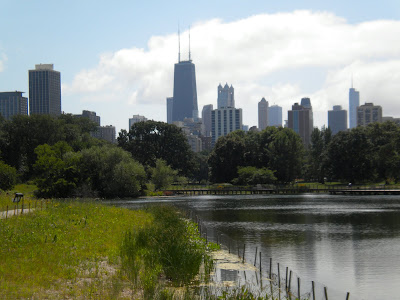
With the end of summer looming, I packed my camera, field guides, and water bottle and headed down to Lincoln Park to see the Nature Boardwalk, which opened in June. The park's South Pond had been under construction for more than a year, with bulldozers and backhoes tearing out the old and making way for the new, native ecosystem. About the only wildlife remaining from the old pond is a colony of endangered herons (in fact, construction was scheduled around their breeding season), as all of the non-native fish that had once called it home had to be destroyed (because it's illegal to release non-native species into local waterways).

The pond was filled and surrounded by regional vegetation and stocked with native minnows, bluegill, turtles, and other wildlife. Filtration systems were installed in the pond to keep the water's pH as close to a naturally formed pond as possible. An island in the middle of the pond and ledges under the bridges were meant to
encourage swallows and other non-aquatic species to take up residence as well.


As much as I enjoyed my stroll around the pond's perimeter, I think the habitat will be far more impressive in a couple of years.
The newly transplanted sedges, grasses, and wildflowers will need time to take root and grow tall enough to cover the ground, and once the vegetation is established, even more species will come to settle in this ecological sanctuary. It was definitely worth the el fare, though!

Tuesday, July 27, 2010

The Reader on Recycling

When I saw this story on the front page of the Chicago Reader, I wanted to bend down and hug the squat little distribution box just north of my el stop. Upon further reading (and it's quite a hefty article, at least by free newspaper standards), I began to wonder whether its author was making legitimate complaints or just adding fuel to this already fiery debate. I've included some of the most telling excerpts below, with minimal commentary, so readers can formulate their own opinions on the matter. The article opens:

If you live in a residential building with four or fewer units, you're supposed to put your recyclables into blue carts and set them out by your trash every two weeks—though ... in most neighborhoods there are no blue carts yet. [Or] you can take your recyclables to one of the city's 33 drop-off centers and hope the bins there aren't already too full.

[But] if you live in a building with more than four units, your garbage is picked up by private waste haulers ... If your hauler isn't recycling, you can press the building owner to comply with the law, but he doesn't really have to fear being fined for violating it. Or you can take your stuff to one of those 33 drop-off centers and hope the bins there aren't already too full.

If you live adjacent to a neighborhood that has the blue carts, maybe you can slip your recycling into the ones across the street, if they're not already too full—but don't get caught, because it's illegal. If you live next to a park, or visit the airports regularly, maybe you can take your materials to their plentiful recycling bins.

Or you can do what most Chicagoans do: say to hell with it.

Confusing, right? I think so, too. A good deal of funds allotted for recycling have been spent on studies, which show that only 8% of waste from city garbage haulers is diverted from landfills (private sector haulers fare slightly better at 19%). Studies also project that this number could easily be raised to 40% in both public and private sectors. So why is Chicago's recycling program still such a failure?

In April, city officials quietly released the results of a pair of studies they'd commissioned to help figure out how to reduce the amount of garbage produced in Chicago. One, a "waste characterization study," sampled trash around the city to determine what Chicagoans are throwing out. It found that we produced about 7.7 million tons of waste in 2007, most of it metals, paper, food and yard waste, plastics, used clothing, and construction and demolition (C & D) debris like concrete and steel.

The other, a "waste diversion study," analyzed what's happening to the city's garbage after it's picked up. It determined that most C & D debris is recycled and reused—as much as 65 percent, the result of a 2005 city ordinance as well as demand for the materials in the marketplace.

But the study also found that even with the high recycling rate for C & D debris, most of Chicago's waste ends up in landfills: 56 percent of metals from homes and businesses, 69 percent of discarded paper, 96 percent of food and yard waste, 96 percent of plastics, and almost all clothing.

The study authors, from a consulting and engineering firm called CDM, offered city officials some straightforward recommendations: offer blue carts citywide, provide more opportunities for residents to recycle clothing and compost organic waste, launch education and outreach programs, and start enforcing recycling laws already on the books. (The studies cost $494,250, about half of which was covered by grants, the rest by funds drawn from the city budget.)

Enforce laws already on the books. That seems obvious to me. So obvious, in fact, that I bristle every time I hear lawmakers debating issues into the ground for which practical (albeit unenforced) solutions already exist. Even more alarming to me, though, are these findings: almost all clothing is tossed instead of being donated!?! 56% of metals, 69% of paper, and 96% of plastics are NOT being recycled!?! And 96% of food and yard waste is NOT being composted?!? Not cool, Chicago. Not cool.

According to the study results released by the city this spring, just 14 percent of the city's waste is produced by the homes served by city garbage crews. About 61 percent comes from the C & D sector, whose efforts are one of the city's few recycling success stories.

The other 25 percent comes from businesses and what the city refers to as high-density residential buildings—those with more than four units, for which garbage collection and recycling are already in the private sector. For the last 20 years recycling in these buildings has been an even lower priority for the Daley administration.

In 1993 the City Council passed the Chicago High Density Residential and Commercial Source Reduction and Recycling Ordinance ... It requires that building owners set up recycling for at least three kinds of materials. If they don't, the city can issue warnings, impose fines of $100 a day, or take away the business licenses of retailers and offices ... In practice, however, the ordinance is almost meaningless, because city officials quickly decided that they didn't want to alienate property owners and building managers by enforcing it.

Well, so much for that idea. The article attempts to leave the Chicago's readers with a glimmer of hope in the closing paragraphs:

In lieu of curbside programs or a coherent high-density policy, the city has created 33 recycling drop-off centers that are well used, to the point where they're often overflowing. In fact, two south-side aldermen recently proposed fining suburbanites who sneak into Chicago to dump their recyclables at city-owned drop-off facilities. From the beginning of the year through the end of May, 1,900 tons of recyclables have been left at the sites, according to Matt Smith.

Recent changes to city and state law have made composting more feasible. The city's website offers tutorials, even for apartment dwellers, and several new commercial composting ventures are opening on the far south side. But for many people—even those with a deep interest in recycling—the city's current web of programs and possibilities is too difficult to navigate.

And where will that leave us, Chicago? Before too long, I imagine it will leave us wallowing in our own waste, because we've been clogging up the landfills with recyclable materials for far too long.

Thursday, July 22, 2010

The Greening of Brownfields

photo via Exelon Corporation site


Stop the presses! Chicago is the Second City no longer! At least not in the realm of environmental initiatives, that is. I personally thought the segment on this Brightfields Initiative that has come to fruition in the West Pullman neighborhood on Chicago's far south side was more of a headline story than an end-of-broadcast blurb, but these days, I'll take my good news any way I can get it.

For those of you unfamiliar with the EPA's Brownfields Initiative, Brownfields sites are perhaps better known as former Superfund sites. These sites, even after successful cleanup and remediation, are ill suited for most types of developments. For example, no one would want to purchase a Brownfields site and build a subdivision or an elementary school, or cultivate a community garden because -- despite even the most successful cleanups -- these sites are still heavily contaminated, it's just that the amount of contamination has been reduced to acceptable EPA levels. So the Brownfields Initiative exists to find viable uses for this spoiled land, such as turning it into a parking lot, or building a big-box warehouse or retail location (with provisions made, of course, for importing potable water).

The Brownfields to Brightfields Initiative takes this task one step further and put solar panels on these undesirable pieces of real estate, which brings clean energy, jobs, and (eventually) power savings to the surrounding communities. And in this, Chicago is leading the nation! Not only is Exelon City Solar the largest urban solar power plant in the country, it's also the first of its kind!

The 32,000 solar panels, which were sourced and manufactured from south side companies, are equipped to follow the rays of the sun as it makes its way across the sky, and will generate enough power to power 1,500 homes. Exelon has leased the 40-acre Brownfield site from the City of Chicago in a long-term deal, and according to the EPA:

"The City of Chicago and Commonwealth Edison have jointly committed $8 million to purchase solar systems in the next five years. The solar systems will be installed on other [B]rownfield sites as well as schools, office buildings, transportation routes, and municipal and commercial properties."


Exelon City Solar will also serve as a demonstration and educational site for other cities that want to harness the power of the sun. So let's hear it for Chicago, solar energy's First City!

Tuesday, July 13, 2010

If You Can't Beat 'em... Eat 'em?

That's exactly what Governor Quinn is proposing we do about our Asian Carp problem. These pesky bottom feeders, which are too bony and taste too fishy for our weak American palates, are apparently a delicacy in China. So our esteemed Governor has partnered with the downstate Big River Fisheries and brokered a deal to market this "wild grown" fish to upscale restaurants in China.

The state's initial investment into this innovative initiative is $2 million to upgrade Big River's two facilities, which are some of the only ones in this state already equipped to handle the processing of these massive fish. Projected benefits of this investment include: 60-180 new downstate jobs, a marked reduction of Asian carp in the Mississippi River, and a local product that China actually wants to import. Quinn said that an estimated 30 million pounds of carp will be exported in the first two years of this venture.

Since this unwelcome species was introduced to American waterways down south nearly 30 years ago, they have been migrating north, largely unchecked, destroying native ecosystems as they go. Currently, their continued push has brought them dangerously close to the Great Lakes. If these fish succeed in reaching Lake Michigan, the results could be devastating to nature and industry alike.

Friday, July 9, 2010

Blue Bin Blues

This front-page story of today's Chicago Sun Times stopped me dead in my tracks this morning. The photo, which showed row after row of unused blue carts-- stacked floor to ceiling and sitting in some southside warehouse-- that have not been passed out to qualifying Chicago households. To be more specific, roughly 359,000 of the 600,000 qualifying residences in Chicago are still waiting for the coveted blue bins to appear in an alley near them.

The blue cart program, which was supposed to have been completed by the end of 2011, ground to a screeching halt when Chicago, along with many other cities across the nation, witnessed their smoke-and-mirrors method of balancing the city budget evaporate along with the nation's economy back in 2008.

Aldermanic proponents of this city-wide program have called the stockpile of pristine blue carts (with an estimated value of $45 each) a "colossal waste of money" and demand that City Hall make recycling a priority once more. Mayor Daley defends his proposal to privatize the city's recycling, which he unveiled last month (just to freak me out, I'm fairly certain), claiming that doing so would cut $40 million of the estimated $60 million it would cost for the city to see this plan through to completion.

I'm including this blurb from The Huffington Post, aptly entitled "Chicago Recycling FAIL", which summarizes the Sun Times article and offers a more pointed reaction to the city's recycling shortcomings. I hate to break it to you, Chicago, but the only thing "green" about the recycling program in this city is our collective envy of the villages, townships, and even other cities that have managed to get it right!

Monday, June 28, 2010

Why Putting-it-out-Back-for-the-Scrap-Metal-Scavengers-to-Take is NOT Recycling!

We've all seen them in the alleys behind our homes... they're about as prevalent as those rat extermination posters the city tacks to utility poles each spring. I'm talking about the scrap-metal guys that skulk through the alley ways in 30-year-old pick-ups trucks, trucks with bad spray paint jobs and hauling beds that have been built up with cheap chain-link fencing, rusty support rods, and splintered two-by-fours.

And who hasn't left an unwanted item off to the side of the dumpster, in hopes that someone else will claim it before the garbage men come? I've been guilty of this myself... both of leaving trash and of finding treasures. Well, this isn't always the best idea. I won't even go into how it provides a way for undocumented workers-- who, let's face the facts, make up the vast majority of these scavengers-- to acquire a tax-free income, even though it does.

For the purposes of this blog, I would like to keep my focus on the environmental ramifications of this phenomenon. I watched from my kitchen window today as my landlord cleaned out the garage. The pile of stuff he had amassed was astounding. Within minutes, along hobbles a rusty pick-up truck, already heavily laden with scrap metal. Not only did these guys stop and gobble up the appliances, electronics, and building materials that my landlord had already dragged to the curb, they (with his blessing) finished clearing the unwanted metal items out of the garage for him, with nothing but dollar signs in their eyes!

As the poor old truck groaned and lumbered out of the alley, I began to wonder what would happen to all the non-metal components of these items once the metal portions had been weighed and sold as scrap. While I don't have the specifics on any particular metal recycling center, if I've learned anything from my haz mat and contaminated properties remediation classes, it's that these scrap metal yards tend to not give much thought to the heavy metals, corrosive liquids, and other hazardous wastes they separate from appliances, electronics in particular. Sure, the metal gets recycled, which is great, but where does the rest of it go? Into our landfills, soil, and drinking water. Not cool.

That said, I'm willing to look the other way for scrap metal items like ironing boards and pipes that don't contain hazardous materials. But when it comes to old electronics, folks, take them to some place like Abt Electronics or the Chicago Hazardous Materials Recycling Center (it's free!) where you can be sure that all the parts of that old computer or behemoth television set will be properly disposed of or recycled. And if you get new appliances, many places will haul your old ones away-- if not for free, then for a nominal fee. Take advantage of and throw your support behind these legit services and quit relying on the scrap metal guys to do the right thing!

Wednesday, June 16, 2010

Privatized Recycling?

Guess what, everybody? Mayor Daley wants to privatize yet another city service! We've already leased the Skyway, possibly the airports, and of course the parking meters (and we all know how well that went over, now that we're paying 5 times as much to park on the same streets we've been parking on for years, taking away free parking on Sundays and holidays...). What could be next, you ask? RECYCLING!

[Insert collective groan and some serious eye rolling here.]

How bad could privatized recycling be, you ask? Well, we'd be paying for it, first of all, and-- once leased-- the city would have little control over things like price hikes and poor service, which is what has enraged so many residents about the parking meter deal. Secondly, who's to say that a privatized company would accept as many types of recyclables as our current (albeit imperfect) system does? And third, if people actually have to make an effort to separate their paper from their plastics, how many will be inclined just to throw the item into the trash?

According to the Chicago Reader, Mayor Harold Washington first put this plan into action back in the 1980s. His successor, Mayor Daley, who inherited the plan when he took office after Washington passed away, has been dragging his feet on the matter ever since. He's concocted a variety of schemes, such as Waste Management's blue bag program (which, as we should all know by now, was an absolute disaster), but hasn't really done much to establish an effective, functional recycling program in this city. Even the blue cart program (which is sloooooowly making its way to 600,000 residential homes in Chicago and estimated to be finished by the end of next year) does nothing to address the remaining 80% of this city's waste, which comes from businesses and multi-unit buildings.

The upside to privatized recycling, should this deal in fact go through? Maybe we Chicagoans would finally have a comprehensive, city-wide recycling program that we can call our own. That's what we really want, isn't it? Well, if so, it's looking like it may cost us... and the final price tag remains to be seen.

Sunday, May 23, 2010

Green Festival 2010

I made my way down to Navy Pier this morning to attend this year's Green Festival, free pass in hand (thanks in part to the shelter where I volunteer). I went a few years back when it was at McCormick Place, and left with an entire bag full of free samples, including laundry detergent, energy bars, beauty products, and paper products. This year's Festival didn't disappoint, and in addition to restaurateurs, trade schools, and natural-products vendors, I noticed quite a few activists and non-profit organizations.

I spent some time chatting with the Environmental Law and Policy group based right here in Chicago, and filled out post cards to my senators and alderman to vote to close the coal plants operating near Pilsen and Little Village. I also picked the brain of a woman working to collect signatures for the Food and Water Watch, a group that was petitioning to have BP's Deep Water Atlantis rig shut down as well, because this well was missing even more safety records than the Horizon, which as we all know, blew up last month.

If I were a home owner, I would have enjoyed learning about geo-thermal energy, solar panels, eco-friendly windows and energy-efficient appliances, but for the time being I just scooted right past. There's a little something for everybody at this festival: fair-trade edibles (from chocolate to coffee) for the foodies; hemp purses and clothing for the tree-hugging hippies; one-of-a-kind pieces of jewelry for the classy folk; organic t-shirts with clever quips or creative graphics for the hipsters; and volunteer/non-profit organizations passionately supporting some noble cause for the do-gooders, like me!

If you can't make it to Navy Pier this weekend, keep the 2011 festival on your radar; for anyone who's even remotely interested in all things environmental, it's worth the price of admission. And if you ride your bike or take public transit, that admission price will be reduced!

Thursday, February 11, 2010

Polystyrene Ban Proposed

Ed Burke, 14th Ward Alderman and Chairman of the Finance Committee, proposed a city-wide ban on polystyrene products-- better known as Styrofoam-- used in the food industry. Though this proposal-- spurred by the realization that Chicago Public Schools are throwing away 35 million polystyrene lunch trays each year; that's more than 250,000 trays a day!-- is a good idea in theory, every time a political figure tries to ban something in this city, people get all up in arms. And Alderman Burke has proposed to ban a lot of stuff: plastic bags, BPA, trans fats, and smoking inside public places. While I agree these would all be in the best interests of the city, the smoking ban was the only proposal to gain any traction. However, he's also had some proposals that were pretty "out there", such as banning carriage horses from pooping on the street (has anyone ever seen a horse in a diaper? Didn't think so) and limiting dogs to 10 minutes of barking within a certain time frame, which is ridiculous on a number of levels.

If passed, this proposal-- like all proposed bans-- would come with fines that would theoretically generate much-needed revenue for the city. However, it should be pretty clear by now that this simply doesn't work; nobody pays attention to these arbitrary new mandates, and few people are fined because these proposals are so hard to enforce. Didn't the city learn anything from the foie gras debacle that made Chicago the laughing stock of the culinary world? Restaurant chefs took pride in breaking that law, which was eventually rescinded. I personally disagree with foie gras from an ethical standpoint, so I don't eat it. Not everyone shares my concern, but banning the end product didn't solve anything, especially not for the force-fed geese.

No Foam Chicago, a grass-roots organization, is backing Alderman Burke's ban, but with the very thing his proposal is lacking: facts. Among the group's top ten reasons to ban Styrofoam, they cite the chemical styrene as a known environmental hazard to human health and reproductive systems. When heated (in the microwave, or by the addition of a hot food or beverage to the container), the chemical leaches into the food and is unintentionally ingested. Also, polystyrene recycling, while possible, is quite costly and largely impractical, so the bulk of these containers wind up clogging our landfills, where they take centuries to break down.

A number of eco-friendly, biodegradable alternatives to Styrofoam packaging in recent years that are more readily available and less cost prohibitive than they were in the past. Giant corporations like McDonald's have phased out their use of polystyrene products (remember when those fried, low-grade burgers used to come in watered-down, pastel-colored clam shells?) without losing profits, and the people who consume these sandwiches are *slightly* healthier because of it.

If Alderman Burke wants to make a change to the polystyrene problem in our public schools, he might be better off playing his "won't somebody think of the children!" card, and working with CPS to find a better solution. Heck-- have the high school science teachers address the problem in their lesson plans, and let the students figure out a better way. Help them help themselves! Do I think Chicago restaurants should get away from using polystyrene packaging? Yes. Is banning Styrofoam and riling up our vibrant restaurant industry the answer? No. I believe the good people of Chicago will respond better to helpful incentives than they will to heavy-handed influence; I'm no Alderman, but I think it's worth a try!

Tuesday, January 19, 2010

So Sue Us!

Oh, wait. They already did... the rest of the Midwest, that is. Michigan started it, slapping the State of Illinois with a lawsuit to stop the migration of the Asian Carp toward Lake Michigan by closing the locks on the Illinois Sanitary and Ship Canal. If you recall, this waterway was the site of a massive fish kill last month, an attempt by the Department of Natural Resources and U.S. Army Corps of Engineers to keep the dreaded fish from swimming past the electrical barriers (a device that emits underwater shock waves, designed to keep these fish downstream) while they were shut off for some routine maintenance.

Michigan's governor, Jennifer Granholm (who I actually like-- she was governor during my time in Ann Arbor) launched the initial suit against Illinois, while Indiana, Ohio, Minnesota, and even New York were quick to jump on her legal bandwagon. Our attorney general, Lisa Madigan (who I also like-- she lives in my neighborhood!) argued that the case was misdirected, because the Army Corps of Engineers, and not the State of Illinois, operates the locks on the canal. If Michigan wanted to sue somebody, it should be them.

Bloggers and reporters have been all over this issue since news of the lawsuit broke about three weeks ago; some claim that Daniel Burnham (the guy who, among other things, had some say over reversing the flow of the Chicago River) is spinning in his grave, while others suggest that Michigan should sue the carp themselves for trespassing. I have no desire to get snarky about the matter; we need to do everything we can to protect the Great Lakes, but crippling the state's shipping industry is not the answer! And for the record, when it comes to lawsuits pitting the environment against industry, industry wins out the vast majority of the time. We need another approach.

That's why I was so happy to hear today that the U.S. Supreme Court refused to hear the case, bumping it back down to the state courts. Something needs to be done, but we need scientists-- not lawyers-- calling the shots here. Hoever, this comes at the same time that biologists are saying that Asian Carp DNA (although not the fish themselves... yet) has in fact been found in Lake Michigan, which is a very scary prospect, indeed. Although Michigan was defeated in this round, they are not deterred; they plan on taking their case to Congress, and are lobbying President Obama to force Illinois to cut off an arterial waterway (although I can't be certain, I'm pretty sure that's not his job...) So we certainly haven't heard the last of this story, but the drama continues to unfold.

Friday, December 4, 2009

"Poison Fest"?

Last night, a murder spree of Biblical proportions took place in a six-mile stretch of the Chicago Sanitary and Ship Canal near Romeoville, which is about 40 miles southwest of the city. The killing was both premeditated and indiscriminate, and the resulting carnage is staggering. I'm talking about a decision by the Illinois Department of Natural Resources to dump 2,200 gallons of rotenone, a toxin that is lethal to-- as some expert on the WGN morning news said (in his best movie trailer narration voice)-- "anything with gills". This drastic measure was taken to prevent the Asian carp from continuing their journey from the Mississippi River into Lake Michigan, which, for the Great Lakes ecosystem (and the commercial fishing industry as well) is a "doomsday" destination.

The Asian carp in question is more accurately known as the Bighead carp; of the five known species of carp in this country, all of them came from Asia. This includes the common carp, which was brought over in the 1830s and is now considered to be a native species. The Bighead carp (along with the Silver carp) were deliberately imported from Eastern China in the 1960s and 70s by catfish farmers and wildlife experts to improve water quality and to control aquatic vegetation. The problem is, these huge fish (with voracious appetites) escaped their enclosures in the 1990s (likely after a flood), and entered a number of waterways in this country, namely the Mississippi River. They're bottom feeders that reproduce freely, and they eat such a ridiculous amount of plankton that it disrupts the entire food chain, established long ago by the many species native to these ecosystems. These carp can range anywhere from 50-100 pounds, and they have an especially disturbing habit of responding to boat traffic by leaping out of the water and slapping their huge, scaly bodies into boaters or fishermen or skiers; a number of people have been injured by these giant, flying fish!

This is just one of many failed attempts to control one biological nuisance by importing a species that is not native to the area, which in turn becomes an even bigger nuisance than the pests it was brought in to control! I'm not in favor of indiscriminate chemical controls, either (like those deployed last night), but I'm afraid I don't have a satisfactory solution to the problem at hand.

So what is rotenone, exactly? According to this article from Reuters, it is a "natural poison that prevents fish gills from absorbing oxygen." It goes on to say that it is "used as a broad-spectrum insecticide and pesticide, kills fish and freshwater snails but does not harm other animals. It dissipates within two days, though authorities plan to introduce a neutralizing agent to speed up the process." More specifically, it is a natural pesticide derived from the roots of tropical and subtropical plants and is used in organic gardening, on household plants, and as flea and tick control on pets. The fish and insects affected by this toxin die slowly, but stop eating almost immediately.

Other sources (which I can't verify, so I won't list here) suggest that it may contribute to mammary tumors and changes in blood composition in pets that accidentally inhale or ingest the stuff, and may possibly be linked to Parkinson's Disease in humans who have had chronic exposure. The sentence that bothered me the most in all of my readings was:
"There is considerable controversy over the use of rotenone to kill non-game fish in water body management areas. One study found that the practice has a substantially harmful effect on biodiversity, in which several populations of the native fish showed negligible signs of recovering stocks, while populations of all exotic species are up."

Invasive species are bad-- I get that-- but the killing of any living creature (an estimated 200,000 POUNDS of dead fish are expected to be recovered within the next couple of days!) on such an expansive scale just doesn't sit well with me, especially since early reports have turned up only one big, bad carp and scads of good, native fish. Surely there's a better way... right?

Monday, July 27, 2009

South Pond

I was walking through Lincoln Park today, and smelled something awful. The stench seemed to be coming from behind a large, makeshift fence, and after a block or so, I stumbled upon this sign, which explained the odor.

Basically, they are transforming the southern pond into an "urban ecosystem", returning native species of fish, plants, birds, frogs, and the like back to the area. I vaguely remember seeing something about the project on the news earlier in the spring; they had to kill off a number of the non-native plants and critters that were inhabiting the pond before the renovation, which made me sad, but I'm all for restored wetlands and furthering the native species and the like.

I'm not quite sure how I imagined they would go about "restoring the natural habitat", but I certainly was not expecting to see this:
Cranes and bulldozers and idle construction workers, oh my! I guess I never figured they'd have to do a complete demolition to make a natural restoration; I expected them to just make improvements to the existing pond. Not so. I'm looking forward to seeing the finished product, which the sign assures me will be "an outdoor classroom for students of all ages", I just find their restoration methods a bit ironic.