Sunday, November 28, 2010

Meigs Field Now Bird Sanctuary

Northerly Island is, by all accounts, an enviable piece of real estate. Located just southeast of the Museum Campus, the peninsula was once home to a little airport known as Meigs Field, which met its now-infamous end back in 2003, when Mayor Richard M. Daley covertly sent a fleet of bulldozers to tear up the runways in the middle of the night, without warning the public or getting approval from any of the city's usual legal channels. Unapologetic in his actions, Daley cited only a concern that having an airfield so close to downtown posed a "terrorist threat", in a very-belated response to the September 11th attacks.

Although pilots and other aviator enthusiasts still harbor a great deal of resentment toward the mayor and his seemingly rash decision, it sounds like Northerly Island will soon become a permanent hub for winged creatures of the feathered variety.

In the years since the runway debacle, the Park District has already made great strides in beautifying Northerly Island. They have done a good deal of prairie restoration on the southern half of the peninsula, and erected the Charter One Pavilion, a 7,500-seat (temporary) concert venue to the north. This article in yesterday's Tribune details how architects plan to unveil green designs for a permanent concert facility (revenue from these concerts will help fund this project) and to restructure the old terminal building, by removing the walls (which have claimed the lives of many a migrating bird) and turning it into an open-air pavilion.

A more concerted effort will be made to turn the island, which is on the direct flight path of many migrating birds, into a bird sanctuary and hospital, while underwater rock formations will harbor many more species of aquatic plants and animals. I walked the length of Northerly Island earlier this fall, and despite a group of tourists on Segways, I found it to be a surprisingly peaceful place. I think a nature sanctuary is a great idea, and the views can't be beat!

Saturday, October 30, 2010

What's in YOUR Water?

Just as many people find it hard to remember life before cell phones, others can barely remember life before bottled water. Do you remember when bottled water was "invented"? I do. We must have all been so primitive and uncultured before then... to think that we all used to drink (*gasp!*) tap water... the horror!

Oh, wait. I still drink tap water, and I think all of you should, too. Now, I'm not normally one to blatantly impose my views on others; as long as your actions aren't affecting me and you're not hurting yourself or anyone else, I'm willing to put up with a myriad of different things. But in this case, I think the actions of bottled water drinkers are hurting themselves and others, and here's why.

We've all heard the alarming statistics of the number of plastic beverage containers that wind up in landfills: they make up 45%-60% of all litter in this country, and the number of bottles discarded last year alone, when stacked end to end, would be enough to reach to the moon and back six times, or something crazy like that. Discarded plastic bottles are also clogging up our oceans, comprising a hefty percentage of the giant patches of garbage floating in our polluted seas; the 21st century version of the plastic six-pack rings people got so fired up about back in the '80s.

I know what you're thinking: "Of course litter is bad. I recycle my plastic bottles. What else have you got?"

If pollution doesn't weigh as heavily on your eco-conscious as it does mine, then consider this. Our government, in its infinite wisdom, passed a great deal of environmental legislation back in the 1970s and 80s, and as a result of pieces of legislation such as the Clean Water Act and the Safe Drinking Water Act, all municipalities have to meet very specific criteria when it comes to the treatment of drinking water. This includes regular, daily testing of the water that comes out of our tap. And no, it's not 100% pure, but some minerals are good for us and we can rest assured that it has been tested for a myriad of toxins, and test results came in below the MCLs for each of those toxins. We can use additional in-home filtration systems as an extra safeguard or if we object to the taste, but know that in the 21st century, the water that comes out of the tap in this country has been thoroughly tested and is safe to drink.

Still not convinced? Then consider this: bottled water came onto the scene several years after the afore-mentioned bills were passed, so our government, in its infinite wisdom, delegated the regulation of bottled water to the FDA instead. The FDA is so huge that it can't really test every product under its jurisdiction to the extent that is sometimes needed, and often approves items (such as water) that are "generally recognized as safe" (GRAS) without closer inspection. The FDA does not investigate advertising claims of "mountain-pure spring water" and the like, and only gets around to testing bottled water every three to six months... if we're lucky.

Independent testing has since revealed that many of these claims are false, and that most bottled water is just packaged tap water. It's rarely cleaner than what comes out of our faucet, and in some cases the level of contamination is worse. If, for example, bottled water is contaminated during the packaging process, it could take months to detect the toxin, and by that time, thousands of people could have already consumed the tainted water. Tap water contamination is detected and remediated much more swiftly than that.

My final argument against bottled water is this: bottled water came about because giant corporations such as Nestle and Coca Cola and the like found a sneaky new way to increase their sales. They've profited so much from designing clever advertising campaigns and making unfounded health claims about the benefits of their bottled water product, they've monopolized and have all but depleted once-public water sources in areas (such as northern Michigan) just to make a buck. Bottled water is the first step in turning a natural resource into a commodity, and that's a slippery slope to venture down.

Water is vital to our very existence, and the thought of allowing large companies to seize our water supplies and claim ownership of this crucial element is terrifying, indeed. So the next time you reach for an Ice Mountain or a Dasani, I challenge you to stop and think about what you're actually drinking!

Saturday, October 2, 2010

Climate Change Exhibit

I practically skipped down to the Museum Campus last week to take advantage of one of the Field Museum's free days, which means reduced-price admission to their normally pricey special exhibits! I've been meaning to go see the Climate Change exhibit (as well as the robotic dinosaurs, which were very cool) all summer, as I'd heard so many good things about it that I wanted to see it for myself.

In my excitement, I arrived at the museum shortly after it opened, and had the entire Climate Change exhibit practically to myself. So I took my time meandering through the aisles, crammed floor to ceiling with historic facts, photos, meteorological diagrams, and flow charts, reading both the interest-piquing tidbits and the heavier scientific evidence behind the findings presented.

Of all the information presented, my only beef with the presentation was with the giant stuffed polar bear picking its way over a mound of garbage. I found the display to be apocalyptic and over the top; the present facts are scary enough, there's no need to make wild predictions about the future.

Although the subject matter was still alarming, it was not alarmist by any means, and I was pleased as punch to see no partisan politics in play whatsoever (which, in my opinion, is exactly as it should be!). The exhibit did exactly what exhibits do best, and that is to present the facts in a clear and concise manner. It's funny, but without partisan rhetoric and cliche talking points, skeptics have a much harder time arguing with the facts!

And the fact is that our planet is getting warmer. The all-encompassing takeaway I left with is that, while the rising temps may be due in part to the natural cycle of the Earth (take heart, skeptics!), our habits and actions as a society certainly aren't helping matters and may in fact be making things worse (hug a tree, hippies!). The exhibit left visitors with a sense of hope, detailing how a few small actions by many could change the trajectory of our future, because the health of the environment and the health of all species (humans are not immune!) are inexorably linked.

Sunday, September 19, 2010

Ding Dong! The Well is Dead!

Ding Dong!
The Well is dead.
Which oil Well?
The BP Well!
Ding Dong!
Macondo well is dead!

Scrub oil off the pelican's head,
pull trawlers along the Gulf Sea bed.
Coast Guard said the oil well is dead!

Say skeptics, "Where'd the oil go?"
Below - below - below.
Yo-ho,
let's open up the beach
and wring the booms out.

Ding Dong the merry-oh,
never mind the slick below.
Let folks know
Macondo well is dead!

BP
The well's been plugged but it's a pity,
Offshore drilling all had to be stopped.
Spillcam's off; we're not the enemy!

USCG
But we've got to verify it legally, to see

BP
To see?

USCG
If she

BP
If she?

USCG
Is morally, ethic'lly

Shrimpers
Spiritually, physically

Fishermen
Positively, absolutely

Tourists
Undeniably and reliably Dead

Adm. Thad Allen
As Admiral I must aver,
I thoroughly examined her.
And she's not only merely dead,
she's really most sincerely dead.

BP
This is a good day for Gulf dependents,
For all marine life, and their descendants

USCG
If any...

All
Yes, let the joyous news be spread
Deepwater Horizon's well is dead!

Tuesday, September 7, 2010

Stearns Quarry Wetlands


I learned of this ecological gem while waiting on the Roosevelt el platform, of all places. The CTA has TV screens at some of the larger stations that encourage passengers to explore different areas of the city by mass transit, by showcasing certain attractions near different el stops. Advertised as being just steps from the Halsted Orange Line station and bus hub, I hopped a train to the south side and spent a morning wandering through one of the Park District's newest open areas and wetlands restoration sites.

The site of this abandoned stone quarry lies just southeast of the Stevenson Expressway, but despite its proximity to such a major vehicle thoroughfare, the quarry is surprisingly tranquil. The topographical variation itself is reason enough to visit; the mound of unused land left by the site's previous industry is now a grass-covered hill, criss-crossed by paved pedestrian walkways, and the mining pit has been filled with water and stocked with native fish and aquatic plants.

The walkway into the park is lined with large stones, a reminder of what the land was once used for, and the water's source is at the site of the quarry's old well. It circles the well in a growing spiral trench until it reaches the edge of the pavement and meanders down the hill into the quarry pit below. Sedges and tall grasses have already taken root in the fertile soils lining the newly formed stream, and should be completely grown in by next summer. Although the fishing area is not yet open to the public, residents are already taking advantage of the open space; runners were tackling one of the largest hills in the city and families were picnicking atop giant boulders.

After I toured the wetlands, I briefly considered continuing south on Halsted to lunch in (and explore) the Bronzeville neighborhood, but was skeptical of the neighborhood that lay in between, so I (somewhat reluctantly) hopped back on the train and made my way north. Kudos to the Park District and the Transit Authority, however, for enticing me to visit a part of the city I wouldn't otherwise have considered!

Monday, August 23, 2010

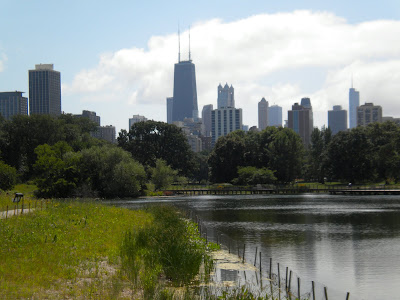
Lincoln Park Nature Boardwalk


With the end of summer looming, I packed my camera, field guides, and water bottle and headed down to Lincoln Park to see the Nature Boardwalk, which opened in June. The park's South Pond had been under construction for more than a year, with bulldozers and backhoes tearing out the old and making way for the new, native ecosystem. About the only wildlife remaining from the old pond is a colony of endangered herons (in fact, construction was scheduled around their breeding season), as all of the non-native fish that had once called it home had to be destroyed (because it's illegal to release non-native species into local waterways).

The pond was filled and surrounded by regional vegetation and stocked with native minnows, bluegill, turtles, and other wildlife. Filtration systems were installed in the pond to keep the water's pH as close to a naturally formed pond as possible. An island in the middle of the pond and ledges under the bridges were meant to
encourage swallows and other non-aquatic species to take up residence as well.


As much as I enjoyed my stroll around the pond's perimeter, I think the habitat will be far more impressive in a couple of years.
The newly transplanted sedges, grasses, and wildflowers will need time to take root and grow tall enough to cover the ground, and once the vegetation is established, even more species will come to settle in this ecological sanctuary. It was definitely worth the el fare, though!

Tuesday, July 27, 2010

The Reader on Recycling

When I saw this story on the front page of the Chicago Reader, I wanted to bend down and hug the squat little distribution box just north of my el stop. Upon further reading (and it's quite a hefty article, at least by free newspaper standards), I began to wonder whether its author was making legitimate complaints or just adding fuel to this already fiery debate. I've included some of the most telling excerpts below, with minimal commentary, so readers can formulate their own opinions on the matter. The article opens:

If you live in a residential building with four or fewer units, you're supposed to put your recyclables into blue carts and set them out by your trash every two weeks—though ... in most neighborhoods there are no blue carts yet. [Or] you can take your recyclables to one of the city's 33 drop-off centers and hope the bins there aren't already too full.

[But] if you live in a building with more than four units, your garbage is picked up by private waste haulers ... If your hauler isn't recycling, you can press the building owner to comply with the law, but he doesn't really have to fear being fined for violating it. Or you can take your stuff to one of those 33 drop-off centers and hope the bins there aren't already too full.

If you live adjacent to a neighborhood that has the blue carts, maybe you can slip your recycling into the ones across the street, if they're not already too full—but don't get caught, because it's illegal. If you live next to a park, or visit the airports regularly, maybe you can take your materials to their plentiful recycling bins.

Or you can do what most Chicagoans do: say to hell with it.

Confusing, right? I think so, too. A good deal of funds allotted for recycling have been spent on studies, which show that only 8% of waste from city garbage haulers is diverted from landfills (private sector haulers fare slightly better at 19%). Studies also project that this number could easily be raised to 40% in both public and private sectors. So why is Chicago's recycling program still such a failure?

In April, city officials quietly released the results of a pair of studies they'd commissioned to help figure out how to reduce the amount of garbage produced in Chicago. One, a "waste characterization study," sampled trash around the city to determine what Chicagoans are throwing out. It found that we produced about 7.7 million tons of waste in 2007, most of it metals, paper, food and yard waste, plastics, used clothing, and construction and demolition (C & D) debris like concrete and steel.

The other, a "waste diversion study," analyzed what's happening to the city's garbage after it's picked up. It determined that most C & D debris is recycled and reused—as much as 65 percent, the result of a 2005 city ordinance as well as demand for the materials in the marketplace.

But the study also found that even with the high recycling rate for C & D debris, most of Chicago's waste ends up in landfills: 56 percent of metals from homes and businesses, 69 percent of discarded paper, 96 percent of food and yard waste, 96 percent of plastics, and almost all clothing.

The study authors, from a consulting and engineering firm called CDM, offered city officials some straightforward recommendations: offer blue carts citywide, provide more opportunities for residents to recycle clothing and compost organic waste, launch education and outreach programs, and start enforcing recycling laws already on the books. (The studies cost $494,250, about half of which was covered by grants, the rest by funds drawn from the city budget.)

Enforce laws already on the books. That seems obvious to me. So obvious, in fact, that I bristle every time I hear lawmakers debating issues into the ground for which practical (albeit unenforced) solutions already exist. Even more alarming to me, though, are these findings: almost all clothing is tossed instead of being donated!?! 56% of metals, 69% of paper, and 96% of plastics are NOT being recycled!?! And 96% of food and yard waste is NOT being composted?!? Not cool, Chicago. Not cool.

According to the study results released by the city this spring, just 14 percent of the city's waste is produced by the homes served by city garbage crews. About 61 percent comes from the C & D sector, whose efforts are one of the city's few recycling success stories.

The other 25 percent comes from businesses and what the city refers to as high-density residential buildings—those with more than four units, for which garbage collection and recycling are already in the private sector. For the last 20 years recycling in these buildings has been an even lower priority for the Daley administration.

In 1993 the City Council passed the Chicago High Density Residential and Commercial Source Reduction and Recycling Ordinance ... It requires that building owners set up recycling for at least three kinds of materials. If they don't, the city can issue warnings, impose fines of $100 a day, or take away the business licenses of retailers and offices ... In practice, however, the ordinance is almost meaningless, because city officials quickly decided that they didn't want to alienate property owners and building managers by enforcing it.

Well, so much for that idea. The article attempts to leave the Chicago's readers with a glimmer of hope in the closing paragraphs:

In lieu of curbside programs or a coherent high-density policy, the city has created 33 recycling drop-off centers that are well used, to the point where they're often overflowing. In fact, two south-side aldermen recently proposed fining suburbanites who sneak into Chicago to dump their recyclables at city-owned drop-off facilities. From the beginning of the year through the end of May, 1,900 tons of recyclables have been left at the sites, according to Matt Smith.

Recent changes to city and state law have made composting more feasible. The city's website offers tutorials, even for apartment dwellers, and several new commercial composting ventures are opening on the far south side. But for many people—even those with a deep interest in recycling—the city's current web of programs and possibilities is too difficult to navigate.

And where will that leave us, Chicago? Before too long, I imagine it will leave us wallowing in our own waste, because we've been clogging up the landfills with recyclable materials for far too long.