Tuesday, January 12, 2010

Brita Filter Recycling Now Available!


I learned something today... and on Facebook, of all places! This program started a year ago today, so I can't believe that this is the first I've heard about it... but it is now possible to recycle Brita filters in the U.S.! This has long been available in Europe, and now Brita has teamed up with Preserve, a company that manufactures household items out of 100% recycled materials, to separate the plastic from the carbon particles and find new uses for both. The program is called Gimme 5, in reference to the #5 (polypropylene) plastic that is used to make Brita filters. Although Chicago does accept polypropylene plastics in their single-stream recycling bins, many cities do not.

To recycle these filters, Preserve asks that we set the spent filters aside and let them dry for a minimum of three days, then wrap them in a plastic grocery bag (don't worry, they'll recycle that, too!). From there, consumers can either take the filters to a designated drop-off location (the link is down at the moment, but I know many Whole Food stores in the area will accept these filters), or-- if there isn't a drop-off location nearby-- save up a few filters, pack them in a (recyclable) box, and mail them into the company at:

Preserve Gimme 5
823 NYS Rte 13
Cortland, NY 13045

The only downfall is that the customer is responsible for the shipping costs. However, John Lively, director of environment and material science for Preserve, assures skeptics that, "we calculated that the benefits of keeping Brita filters out of landfills outweigh the impact of shipping them for recycling through this program." Environmental groups such as the Sierra Club applaud Brita's efforts to expand on their "Filter for Good" campaign, which launched in 2007, and encourages people to ditch bottled water and drink filtered tap water instead. So I'll give three cheers to Clorox (the parent company of Brita) for setting an example for other large corporations by putting a portion of their profits toward fighting the good fight. Hip, hip, HOORAY!

Monday, January 4, 2010

I Resolve to...

... save the planet, one drop of water at a time. My environmental resolution for 2010 is to conserve more water. I switched to a low-flow shower head over the summer (this was a second attempt, as I couldn't stand the first shower head I tried) but in my last apartment, I got into the bad habit of leaving the water running while I washed the dishes, as there was no room to wash, rinse, and dry. It's terrible, I know. With less than 3% of the world's water able to be used as drinking water, every wasted drop contributes to water woes of the future.

This may not seem like a big problem here in Chicago, as we have one of the largest freshwater lakes right at our doorsteps, (seen above in this skyline shot from Promontory Point in Hyde Park, on a day much nicer than today) but the lack of fresh water is already a reality in parts of Africa and Asia, and-- albeit to a lesser extent-- in parts of the American southwest and the plains states! Some city and state governments have already imposed water restrictions for activities such as watering the lawn or washing the car during the warm summer months, and experts predict that these restrictions will only grow in the coming years.

Warning signs are everywhere; the Colorado River no longer reaches the sea, and the Odwalla aquifer (main source of water for the western plains states) is nearly dry. Scientists fear that the wars of the future may be fought over water, instead of boundary lines or religious differences. That's quite a prediction, but given that water is one of the basic necessities of life, I can see how its scarcity may someday become a contentious issue. But if you don't believe me, then rent a documentary like Flow: For the Love of Water. It's a bit preachy, but raises a number of very real concerns in terms of water conservation. However, I wouldn't recommend watching it before bed; you just might have to sleep with the lights on.

This is why it makes me nuts to see my rich neighbors run their automatic sprinkler systems in the rain, or when the bartender at work leaves the water running even when he's not washing dishes at all, or when people have a leaky faucet that they're just too lazy to fix. And don't get me started on those hyper-sensitive automatic flushers that are triggered by even the slightest movement; I've had toilets flush on me as many as three or four times, while I'm sitting there! It's gross... and wasteful. However, until I get my dish washing habits under control, I don't feel like I have any real room to talk. So watch out, world, because this "Earth" girl is reaching out to embrace another element!

Monday, December 21, 2009

The Conservationist's Christmas

I'm pleased as punch with all the terrific and eco-friendly alternatives to gift buying, gift giving, and even gift wrapping that are cropping up both in stores and on the Internet these days. I don't know whether it's a result of increased environmental awareness, the prolonged economic recession, or both, but there are so many alternatives now to the commercial consumerism trend that has dominated Christmases past that it has become hard-- even for those who equate Christmas with presents and presents only-- for people not to consider the impact of their purchases!

When it comes to buying gifts, the options are as varied as the gift givers themselves; there's bound to be something for everybody! For the person who has everything, a donation can be made in their honor to any number of charities. Whether it's a charity that holds special significance for the gift recipient or an organization that puts the money toward a more specific purpose, such as rescuing a penguin or providing seeds for farmers in Africa, the gesture is appreciated and the money is put to good use. While these aren't always the most exciting gifts to receive, I really think it is more representative of the true meaning of Christmas than, say, a Play Station, because you're giving for the sake of giving and helping those in need, even though you're not getting anything (tangible) in return.

Another option would be to purchase fair-trade goods or seek out companies that are pledging to donate a portion of their profits to a specific cause or charity. I managed to do both when I bought fair-trade coffee for my brother-in-law; not only were workers in a far-away country getting a living wage for their product, a part of the proceeds went to feeding orphans as well! Then, of course, are the artisans and companies that use recovered, reclaimed, or recycled goods to make new and one-of-a-kind merchandise. They turn trash back into treasure by making purses out of old seat belts or colorful necklaces out of discarded magazines; the offerings are quite varied, and very creative!

When it comes to wrapping all these environmentally responsible, one-of-a-kind gifts, there are a number of equally Earth-friendly options available. I purchased a number of decorative gift boxes back in January; they already look like they've been wrapped, so I just add a bow and call it a day! Same goes for gift bags... I don't think I've ever purchased a new one of these, I've just repurposed the bags from gifts that I've received!

And for those odd or irregularly shaped items that just won't fit in a box or a bag, consider using butcher's paper instead of traditional wrapping paper (which is not recyclable!). Dress it up by adding a bow, and save a tag by writing directly on the paper! Some people have suggested purchasing fabric remnants and using those in place of wrapping paper; maybe if I'm at a craft store during their after-Christmas clearance sale, perhaps I'll look into it. I've also lobbied for saving and reusing gift tags (the tie-on tags, not the sticky tags-- I'm not that bad!) because it requires minimal storage and will save time when labeling gifts for next Christmas.

So what are you doing in the name of conservation this Christmas? I think my favorite idea this season has been the second-hand Christmas my sister is having with her husband and in-laws. All the gifts have to be a hand-me-down or a "regift", or from a second-hand or antique store or a garage sale. That's one sure-fire way to avoid the mall-- I can't wait to hear what they got! I think if I were to participate in a gift swap like that, I would throw the option of supporting charities or purchasing fair-trade or repurposed goods into the mix; now that would be a conservationist's Christmas!

Friday, December 4, 2009

"Poison Fest"?

Last night, a murder spree of Biblical proportions took place in a six-mile stretch of the Chicago Sanitary and Ship Canal near Romeoville, which is about 40 miles southwest of the city. The killing was both premeditated and indiscriminate, and the resulting carnage is staggering. I'm talking about a decision by the Illinois Department of Natural Resources to dump 2,200 gallons of rotenone, a toxin that is lethal to-- as some expert on the WGN morning news said (in his best movie trailer narration voice)-- "anything with gills". This drastic measure was taken to prevent the Asian carp from continuing their journey from the Mississippi River into Lake Michigan, which, for the Great Lakes ecosystem (and the commercial fishing industry as well) is a "doomsday" destination.

The Asian carp in question is more accurately known as the Bighead carp; of the five known species of carp in this country, all of them came from Asia. This includes the common carp, which was brought over in the 1830s and is now considered to be a native species. The Bighead carp (along with the Silver carp) were deliberately imported from Eastern China in the 1960s and 70s by catfish farmers and wildlife experts to improve water quality and to control aquatic vegetation. The problem is, these huge fish (with voracious appetites) escaped their enclosures in the 1990s (likely after a flood), and entered a number of waterways in this country, namely the Mississippi River. They're bottom feeders that reproduce freely, and they eat such a ridiculous amount of plankton that it disrupts the entire food chain, established long ago by the many species native to these ecosystems. These carp can range anywhere from 50-100 pounds, and they have an especially disturbing habit of responding to boat traffic by leaping out of the water and slapping their huge, scaly bodies into boaters or fishermen or skiers; a number of people have been injured by these giant, flying fish!

This is just one of many failed attempts to control one biological nuisance by importing a species that is not native to the area, which in turn becomes an even bigger nuisance than the pests it was brought in to control! I'm not in favor of indiscriminate chemical controls, either (like those deployed last night), but I'm afraid I don't have a satisfactory solution to the problem at hand.

So what is rotenone, exactly? According to this article from Reuters, it is a "natural poison that prevents fish gills from absorbing oxygen." It goes on to say that it is "used as a broad-spectrum insecticide and pesticide, kills fish and freshwater snails but does not harm other animals. It dissipates within two days, though authorities plan to introduce a neutralizing agent to speed up the process." More specifically, it is a natural pesticide derived from the roots of tropical and subtropical plants and is used in organic gardening, on household plants, and as flea and tick control on pets. The fish and insects affected by this toxin die slowly, but stop eating almost immediately.

Other sources (which I can't verify, so I won't list here) suggest that it may contribute to mammary tumors and changes in blood composition in pets that accidentally inhale or ingest the stuff, and may possibly be linked to Parkinson's Disease in humans who have had chronic exposure. The sentence that bothered me the most in all of my readings was:
"There is considerable controversy over the use of rotenone to kill non-game fish in water body management areas. One study found that the practice has a substantially harmful effect on biodiversity, in which several populations of the native fish showed negligible signs of recovering stocks, while populations of all exotic species are up."

Invasive species are bad-- I get that-- but the killing of any living creature (an estimated 200,000 POUNDS of dead fish are expected to be recovered within the next couple of days!) on such an expansive scale just doesn't sit well with me, especially since early reports have turned up only one big, bad carp and scads of good, native fish. Surely there's a better way... right?

Sunday, November 22, 2009

Sticking it to the "Mon" ... Santo, that is


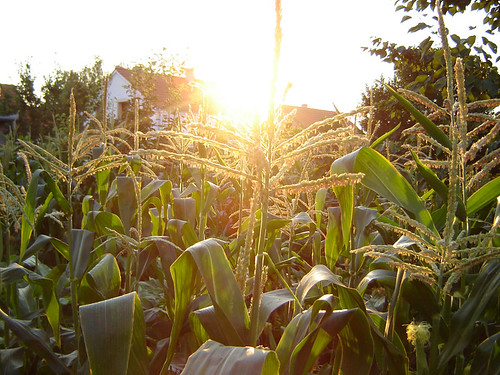
Corn Dusk, originally uploaded by Dodo-Bird.

You can have your fantasy football teams, but I'd rather spend a lazy Sunday laying the groundwork for a fantasy class-action suit that's been knocking around in my head. This fantasy suit of mine pits innocent and hardworking farmers against the greedy, multi-national agricultural companies that sue farmers who save and replant their own seed into permanent submission, and instead force them to purchase their patented, genetically modified products. The source of my defense actually comes from a small section of environmental law meant to pertain to real estate: the innocent landowner defense of the Comprehensive Environmental Response, Compensation, and Liability Act (better known as CERCLA).

CERCLA is a massive piece of legislation; I took a semester-long class that focused only on the innocent landowner (and contiguous property owner) defense within CERCLA, and we only just scratched the surface. The focus of the class was on conducting site assessments for potential purchasers of industrial real estate, but with my brain working the way that it does, the potential implications outlined in this defense gave me another idea.

Let me preface my fantasy class action by saying that I am not a lawyer. I'm not shouty or argumentative, I can't talk in circles, and I detest legalese, which means that I will probably never be a lawyer, because I would be lousy at it. Nor am I a farmer, I just sympathize with those land stewards who are trying to stay afloat in the seriously messed up, over-subsidized and overpriced crop monoculture that is big agriculture in this country. I first became aware of the shady, underhanded dealings of these multi-national corporations-- who have crossed a moral and ethical line by genetically modifying crops and obtaining patents not only for the seeds but for the crops they produce-- through documentaries and books such as The Omnivore's Dilemma, Food, Inc. and The Future of Food.

Each of these resources acts as an exposé into the seedy dealings of these seed businesses, who make the purchasers of their seeds sign over their souls, while going after the farmers who don't want to do business with them and suing them for saving their own seed. Of the farmers who chose to fight Monsanto in court, the few who didn't immediately submit to the settlements (on the condition of silence) and start purchasing Monsanto's "cutting-edge biotechnology" wound up losing millions before eventually losing their lawsuits. These companies are simply too rich and too powerful for individual farmers to take on... hence the need for a class action!

A number of farmers spoke out against Monsanto's practice of sending out "investigators" to bully and intimidate farmers whose properties were adjacent to their customers' farms into buying their products as well, an action Monsanto at once denies then claims is at their customer's insistence. Although these persecuted farmers came from all over the continent, their stories were all pretty much the same. Monsanto tested their seed, supposedly found their patented technology, and took these farmers to court. Monsanto has a number of articles denying these claims on its website, and boasting that the validity of their patents on living organisms was reviewed and upheld as recently as 2007 (patents come up for review every 20 years or so-- this is not good news!) They also cite specific cases against the farmers who were brave enough to speak up, listing all the reasons why the farmer-- and not their corporation-- is in the wrong.

So who are we to believe? A greedy, international corporation that is raking in record profits and steering this country into another dust bowl era, or a nation of beleaguered farmers who just don't have the resources to fight the good fight? I can't say for sure... but in case you couldn't tell, my allegiance is with the farmers.

I will concede that there are a couple of factors that complicate my argument. First, we have to establish that Monsanto's patented, genetically modified seed is a contaminant and-- more specifically for the CERCLA defense-- a hazardous substance. Non-GMO farmers certainly consider even trace amounts of Monsanto's patented technology that appear in their carefully saved, cleaned, and stored seed to be a contaminant, because it's not wanted! In this legislation, a hazardous substance is defined as, "...such elements, compounds, mixtures, solutions, and substances which-- when released into the environment-- may present substantial danger to public health and welfare or the environment." While Monsanto's seed in and of itself isn't a hazardous substance, the effects of eliminating biodiversity and monopolizing the agricultural industry is an environmental hazard, and the ridiculous surplus of corn and other grains grown in this country each year does pose a danger to public health and welfare in that food scientists keep finding new and sugary ways to get us unsuspecting consumers to eat (and drink!) more and more of this stuff. Furthermore, I don't think it would be too hard to make a connection to the obesity epidemic and the increased consumption of corn-based foods; in fact, some of the resources listed above already have! And second, we'd have to find a way to hold our own against the scores of shouty, argumentative, legalese-loving lawyers employed by Monsanto, whose sole job would be finding ways to prove us wrong.

In the case of chemical contamination, liability can be difficult to prove, especially if the original contamination source is not located on the property in question. This makes it hard for current owners/operators and prospective buyers of the land in question to qualify for the innocent or contiguous landowner defense, and even when they do, there is still no guarantee that they will be exempt from liability. As for my argument against this biological contamination, however, Monsanto's coveted patents would make it incredibly easy to trace, identify, and prosecute(!) the responsible parties. The CERCLA legislation is one of the few environmental policies that actually has any teeth and-- like most tax laws-- is designed in a way that makes any potentially responsible parties "guilty, until proven innocent". And the best part about CERCLA is that it's retroactive; even if these corporations can get away with these shenanigans now, if Congress comes to their senses at some point in the future and repeals the right to patent seeds, these corporations will be liable for contamination that occurred before and after these changes are made!

Without getting too much into the due diligence of the matter-- which really only pertains to potential buyers-- for the sake of my argument, I'm going to say that the farmers owned their properties before the contamination source appeared. Assuming due diligence has been proven, the imaginary farmers I'm representing would have to meet certain conditions to qualify for the innocent landowner defense, such as:

  • The contaminants migrated onto their land from other properties despite due care. The most likely cause of seed contamination is by cross-pollination of the innocent farmers' crops with genetically modified crops from neighboring farms. There is a clause in the innocent landowner defense (I don't remember which one, and will only look it up if somebody really wants to know... I'm not a lawyer, remember?) stating that landowners cannot be held responsible for contamination that occurred as a result of an act of nature.
  • They have no knowledge of/no reason to suspect contamination. Unfortunately, this would eliminate any farmer who plants even a portion of their fields with patented seed; basically, once you sign Monsanto's "seed steward" agreement, they pretty much own you whether the seed in question is theirs or not. Also, if the purchaser "contributes" to the contamination, the I.L.D. cannot be applied. But innocent farmers cannot be held responsible for unknowingly "violating" an agreement that their neighbors made with a seed company!
  • They acquired either the land (or, in this case, the contaminated seed) through inheritance or bequest. One of the cases Monsanto describes on their website involves contaminated seed given to a farmer by a relative. Even without my fantasy defense, Monsanto was unable to prosecute the innocent farmer to the extent that they would have liked.

Even if my class-action farmers were able to qualify for the innocent landowner defense, they would still probably have to make a "contribution" to the EPA toward the remedial actions necessary to remove the contaminant from their seeds. Under CERCLA, the current owner/operator of the land in question is automatically considered a potentially responsible party. In the case of "strict" liability, the farmer would likely be stuck with the cleanup costs. So we'd be pushing for "joint and several" liability, where the EPA examines all PRPs and goes after the one(s) with the deepest pockets. In this case, there's no doubt that would be Monsanto. The small settlement the farmers would have to make is known as a de minimis settlement, and it would also protect them from later being sued by Monsanto (should it be determined that they were indeed the contributors of this contamination) to recoup some of the costs of remediation.

A remedial action is defined as a "...remedy that is protective of human health and the environment and maintains protection over time". This is a long-term process, because Monsanto (for the sake of my argument) would have to find the best and most cost-effective solution. CERCLA liability is generally limited to the remediation costs plus up to $50 million to cover natural resource damage (read: contamination of the innocent farmers' crops). However, I would go on to argue that the release of their patented, biological contamination was done willfully. Surely they know that, before they started concocting corn in a test tube, plant pollination occurred naturally. The fact that they're hunting down farmers who aren't buying their seed is evidence enough that they were relying on some level of cross pollination (contamination) to occur.

If we could prove that, then there would be no limit to the amount of money Monsanto would have to fork over to clean up the mess they've created. This would likely involve quantifying what amount of "trace" contaminant is acceptable (and amending their precious patents... or better yet, doing away with them altogether!); this amount would have to be considerably higher than they'd like, to account for the promiscuity of pollinating plants. If they don't like that idea, then they would need to put their mad scientists to work developing a genetic hybrid that a) doesn't pollinate with other varieties of seed or b) is asexual and unable to pollinate at all. They clearly enjoy playing God, and make their customers buy brand new seed each year as it is, so it shouldn't make any difference whether or not their test-tube crops can reproduce! That's the only way they could ensure that their precious biotechnology wouldn't wind up in unsuspecting hands, thus allowing the farmers who choose to sow their crops in the age-old way (that nature intended) to do so, without fear of prosecution.

And that is how I would help David fight Goliath. Clearly, if this were ever to become an actual defense, I would need to get a law degree, read the entire CERCLA Act, flesh out my arguments, and brace for a long and ugly battle. So what do you think? Should I keep my day job or start fielding calls to be some environmental lawyer's next Erin Brokovitch? Is my idea crazy, or crazy enough to work? Who's with me? Let's "stick it to the Mon(santo)" and help farmers everywhere take back their fields!

Friday, November 13, 2009

Seeding the Clouds

When we woke up to a veritable snow storm on our last day in Beijing, having enjoyed pleasant 70-degree weather just the day before, I was baffled. I later learned that the clouds had been "seeded" earlier in the week, which supposedly induces rainfall. I didn't know what that meant. In fact, I hadn't even heard of this practice until it backfired on the first of this month, spoiling our last day of vacation, and causing an international stir by creating one of the earliest Beijing snowfalls on record. But it turns out that cloud seeding is nothing new, and when it comes to the controversial practice (to say the least!) of messing with the weather patterns, China is leading the way.

In one 2006 report, the Chinese government spends about $50 million (USD) a year in their attempts to control the weather. (Current estimates are as high as $90 million!) It is estimated that China sends cloud-seeding aircraft on roughly 700 missions per year, loaded with a comparable number of rockets and artillery shells that are filled with chemicals such as silver iodide and mixed with dry ice. These rockets are then shot into the atmosphere in hopes that the chemical particulates released will aid in the formation of water vapor, which will then fall to the Earth as rain.

Although China has had a moderate amount of success with this practice, bringing much needed rain to drought-stricken areas and helping to extinguish raging forest fires in remote regions of the country, the path that they are heading down is a slippery slope indeed. Rumor has it that they made attempts to ensure sunny, favorable weather for the Summer Olympics, which were held in Beijing just last summer, by using this practice to coax rainfall out of any potentially moisture-rich clouds headed toward Beijing, inducing the rain to fall prematurely so as not to ruin their moments in the spotlight. I couldn't find any proof of whether this worked, though, or if it's even true. The skies were sunny, sure, but Beijing has been suffering from a nearly decade-long drought, so the scientists' claims may be more arrogant than they are accurate.

So arrogant, in fact, that they've done it again; created an unseasonal snowstorm that has, according to an article published today, already killed 40. In China's defense, they're not the only ones trying to outsmart Mother Nature; weather modification experiments have been going on in Europe, Asia, and even the U.S. for more than 50 years. Proponents of this practice argue that the main chemical components of the rockets-- silver iodide (which is found in iodized table salt) and carbon dioxide (found in the atmosphere)-- are harmless. Everything has a toxicity level, though-- even water! And who's to say what the long-term effects may be from prolonged exposure to these chemical rains?

The Chinese, however, are unapologetic in their cloud-seeding efforts. It seems to me that they plan to advance their civilization as rapidly as possible, and will only deal with the consequences when they (inevitably) arise. I'm all for scientific breakthroughs and development, but there's a fine line between weather modification and playing God; if it's not done responsibly, they'll have to answer to Mother Nature in the end, and she's quite a force to be reckoned with.

Saturday, November 7, 2009

Obese Packaging

I came to the startling realization the other day that the shape of our bodies and the shape of our packaging has undergone an alarmingly parallel transformation over the past 50 years or so ...

Using soda as an example, let's first consider the 8-ounce bottle of Coke. This is one serving size of carbonated goodness, served up ice-cold in a glass bottle that -- once empty -- was returned to the bottler, who would carefully wash, sanitize, and refill the container. People took good care of these bottles (the fact that there was a small monetary incentive to do so certainly didn't hurt!) and, on average, bottlers were able to reuse the glass packages 25-30 times before the paint would start to fade and they were forced to take the bottles out of circulation. People also took better care of themselves back then; they kept portion sizes in check and put forth a little extra effort to keep themselves in circulation (so to speak).

By comparison, the 20-ounce bottle of Dr. Pepper on the left crams two and a half servings into it's shapeless plastic packaging, and -- despite the serving size on the label -- we generally pour all of that sweet, sugary liquid down our gullets in a single sitting, transferring the contents of the bulging container into our bulging bellies. Then we carelessly discard the single-use containers, thinking little of the cost, energy, and oil it takes to create a new container for yet another super-sized serving of soda. If we're lucky, the plastic bottles will be recycled, but this doesn't often happen.

Think about it -- the small, svelte, and shapely bottle of Coke could swap clothes with Barbie ... the big, bulging bottle of Dr. Pepper would be resigned to covering up in a flowing, shapeless mumu. Guess the phrase "you are what you eat" should extend to beverages, too!